Making the Web. Faster
@QiWenWang1|June 23, 2021 (about 5 years ago)|3 min read
Following our Series B last December, I'm happy to announce we've raised a $102M Series C (opens in a new tab) from existing and new investors.
Our vision of the Web is a global realtime medium for both creators and consumers, where all friction and latency are eliminated.
We'll use this investment to:
#1. Build the SDK for the Web
Unlike other software development platforms, the Web never came with an SDK or Standard Development Kit.
While new browser APIs are constantly being added, the responsibility still falls on the developer to assemble them into an engine for every new project.
The resulting diversity of tools and choices makes the Web the innovative and dynamic medium that it is, but it can also be a major obstacle, as companies rally to reinvent themselves in the digital medium.
React, now 8 years old (opens in a new tab), has proven to be a durable abstraction and building block (opens in a new tab), a narrative violation of the common wisdom that "frontend frameworks are changed every week."
Next.js builds on this formidable foundation to give developers and companies a meaningful starting point to build great pages, open sourcing the lessons (opens in a new tab) learned from the giants of the Web.
#2. Lower the barrier of entry
Vercel has (opens in a new tab) given (opens in a new tab) developers (opens in a new tab) access to global infrastructure to deploy and scale frontend projects. But significant challenges remain to frictionless collaboration:
- Setting up and maintaining your developer environment
- Integrating it into Git for continuous integration
- Manually pushing and waiting to share progress with your team
Perhaps the most incredible aspect of the Web is that it's not a read-only medium. Each Web browser is simultaneously the consumption and creation mechanism (opens in a new tab).
With Next.js Live (opens in a new tab), we want to build a Web that everyone can contribute to. Whether it's to pitch in an idea or an edit, by an experienced developer or a new designer, from a local editor or the browser itself.
#3. Focus on the end-user
A particularly interesting challenge of building a platform and tooling company is that you have two users (whether it's acknowledged or not):
- The user of the tool
- The user of the output of the tool
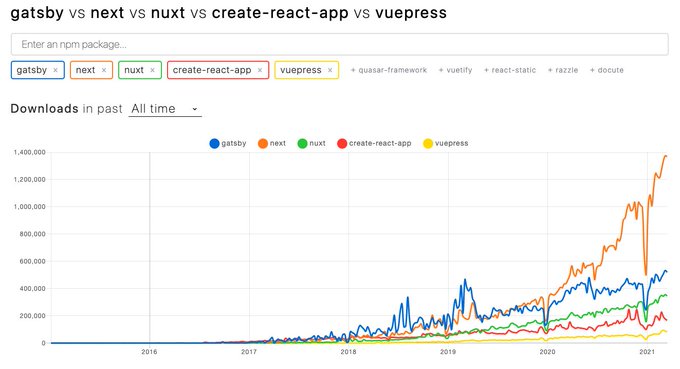
No matter how many downloads Next.js gets, or how delightful and realtime the development experience, a universal truth remains: the customer is king (opens in a new tab).
Performance for the end-user has been baked in the design of everything we make. To name some examples:
- Next.js was born out of the insight that React in its initial Single Page Application presentation was putting the rendering burden on the user's device that should have been on the server (opens in a new tab) instead.
- Vercel Analytics (opens in a new tab) prioritized giving you a Real Experience Score calculated by each device, rather than just listing traffic stats or TTFB latencies.
- Pre-rendering at build time or via Incremental Static Regeneration (opens in a new tab) is all about taking the CPU cycles entirely out of the page serving equation, removing latency for the end user.
Our primary fitness function is your success for your customers. Not every visitor might understand fully how every page is built, but if the experience is delightful and fast, they ought to think it was powered by Vercel.
Related writing
Measure the User Journey, Not Just the Server
A service can be healthy while a reader is still unable to complete the task that brought them to the site.
Frontend · Web Performance
Static Hoisting
Exploring Static hoisting, the process of moving static assets to the edge, where they can be served with maximum speed and reliability.
Web Performance · Frontend
7 Principles of Rich Web Applications
7 actionable principles for websites that want to make use of JavaScript to control their UI and deliver the best performance
Frontend · Web Performance